Showing posts with label Novel. Show all posts

Wednesday, March 29, 2017

They Don't Fit in the Pocket

I must have been in Class 7 when I read my first Hindi pulp fiction. It was a novel named Sile Huye Honth (Sewn Lips). The hero of the novel was Major Balwant who was a private detective and I had smuggled the thin book out of Dad's trunk of books. It was supposed to be out of my reach but I managed to get it out. So, I had to turn to a criminal to get to read my first Hindi detective novel. The name of the author was Colonel Ranjit but I didn't know that it was the pen name of Maqbool Jallandhry. I don't remember the names of the members of Balwant's team. But I remember that he had a dog whose name was Crocodile.
The other thing that I remember very well is the monthly newspaper bill. There was this bookstall near the bus stand from where I used to take a bus on my way back from school. Our household newspaper used to come from there. At the beginning of a month, Dad or Mom would settle the bill for the previous month - which would be roughly 100 to 120. But the next month, the monthly bill had increased by ₹400 or so. And I had to plead with Mom to pay off the bill without raising any alarms.
You must have already made a guess. So, it was still the days when a Hindi pulp novel was priced at most at ₹20. It was very rarely that one of those cost ₹25. And I had managed to raise a bill of ₹400.
Before talking about the Hindi pulp novels, there's one curious fact you should know. Though they are popularly known as pocketbooks, so much so that most publishers have Pocket Book in their name, apart from that first book I had never found any Hindi pulp novel that really fits into my pocket. Though the dimensions are almost pocket-sized, the thickness is out of pocket.
So, who were the authors whose novels were inflating the newspaper bill?
There was Ved Prakash Sharma. He had his Vijay-Vikaas series – which can be broadly called spy novels though there was some extra-terrestrial stuff now and then. Those were mostly patriotic works. See the names of some of the novels from this series: Maati Mere Desh Ki (Soil of My Country), Tiranga Jhukega Nahi (The Tricolor Will Never Bow). The best thing in the Vijay-Vikaas novels was the silly banter that Vijay indulges in to hide his real intentions. Those were some of the funniest monologues I have read. But his crime novels were something else altogether. Some of them have created records in Hindi pulp novel history. One of his crime novels Vardi Wala Gunda (Goons in Uniform) created sales history on the first day of release. If I remember correctly, his novel Wo Saala Khaddarwala (That Darn Politician) was priced at ₹50. It was the first Hindi pulp novel to be priced so high. As I said before, Ved Prakash Sharma had created lots of milestones in the pulp novel history. Those of you who are Bollywood fan may or may not know that the Akshay Kumar hit movie Sabse Bada Khiladi was based on Sharma’s novel Lallu. There were few other movies too that were either written by Sharma or based on his novels; the ones I can remember include the movie Bahu Maange Insaaf (based on the novel of the same name) and another Akshay Kumar movie International Khiladi. Some of his crime or thriller novels include Raam Baan, Kaarigaar, Qateel Ho To Aisa, Shaakahari Khanjaar. It is impossible for me to recall the names of all the thrillers, crime or spy novels written by Ved Prakash Sharma.
The next name I am going to mention is the most recognized name of all Hindi crime, thriller, detective novel writers: Surendra Mohan Pathak. His novels are getting translated into English. They are widely popular. Let me try to recall all the series Pathak writes: Vimal series, Jeet Singh series, Sunil series, Sudheer series. These are the ones I have read. But there are many more series he regularly writes. There are also non-series thrillers coming from his pen all the time. One of the things I remember is that he used to have very informative forewords for his novels: the forewords talked about detective literature from other corners of the world.
One thriller writer that keeps coming up in my mind is Tiger. I don’t remember many of his novels though I am sure I have read a lot. I remember only two of his novels. The first one is: Mujhe Janm Do (Give Me Birth). There are two reasons I remember this. First, the ways the different murders were executed. In one instance, a doctor in the operation theatre is forced to commit suicide. In another murder, the barrel of a pistol is manipulated to make a close shot look like a long-distance shot. But more strikingly, the thriller was based on illegal abortions of female fetuses. It was an issue that hit me hard. The other novel of Tiger that I remember is Teesri Kaun (Who is the Third One). Again, there are two reasons for remembering the novel. One is a scene towards the beginning of the novel – when few female friends meet at the home of a friend to celebrate the birthday of the latter. During the night, one of the friends gets killed. When the police come to investigate, in different rooms of the building they discover a horde of killing equipment – revolver, knife, poison, etc. It was like a get-together of killers trying to kill each other. It was a fantastic scene. Then, there was the killer – the third person of the title; she never lies but the police are unable to identify her till the very end. There was another novel by Tiger: 13 Saal Ki Budhiya (Old Woman of 13 years); it not just dealt with corruption in the country but also had a few horrific descriptions of child prostitution. I could never forget that horror. Tiger was also really adept at creating remarkable characters.  
Among the other Hindi thriller writers I was reading, I can only recall Raj, who was quite popular at that time. But I can’t remember much about his novels except the name of one thriller: Miss India Hatyakand (The Murders of Miss India).
Even though I was quite hung up on these pulp novels, I stopped reading one writer after another. The reason was quite simple. I started finding the blatant plagiarism in most of the novels I was reading. In the case of one writer, I found plots stolen from Hollywood movies including Minority Report, Paycheck, and so on. In the novels of another popular author, I saw plots lifted from Perry Mason novels and served with minor variations to Indianize it. The most famous novel series from the same author was about an antihero: a criminal who was betrayed by his life partner and a partner-in-crime and then he starts off on his journey of revenge. Remember Parker by Donald E. Westlake? It was almost the same plot with minimal changes to make it Indian. 

So, that was that. The end of my affair with Hindi pulp fiction. Maybe not all of their novels have stolen plots. But after finding these dark origins of the novels of some of the authors, I just lost interest in reading any of the authors any more.
Some years later I got lucky because some of the novels of Ibn-e-Safi were translated and published in Hindi, and I became a fan of this long-dead writer. His were very short books but they were great reads.


Monday, May 14, 2012

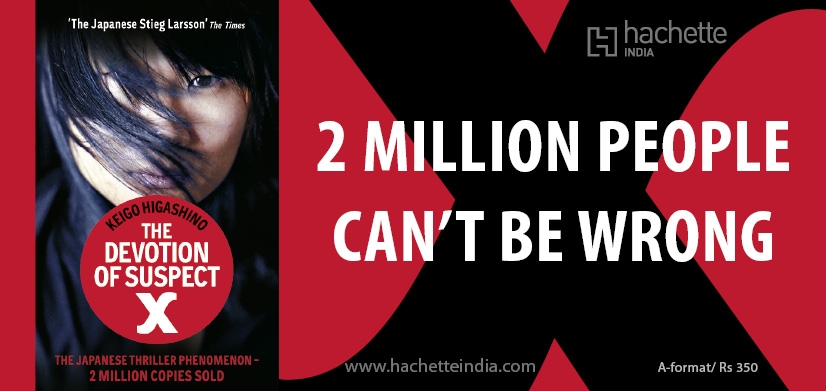
The Devotion of Suspect X

To start with a confession, this review is overdue. It is for the fact that I had had to read this novel cover to cover twice. Then only I could pick up my keyboard to type a review.

Now that I am starting the post, I am a bit apprehensive.

What do you write about a book of which 2 million copies have already sold, based on which there is already a cult movie in Japanese and whose author is hailed as the Japanese Stieg Larsson. What more is there to write then?

Let me start gently with the bare facts of the novel.
Yasuko is a divorced mother with a teenage daughter Misako and working in a small food shop. Not yet free from the shadows of her past, her ex-husband keeps on harassing her for money while she keeps on changing her job and household to escape him. But on his latest harass trip, Yasuko bravely stands up to him refusing to pay him any more. So, to further harass the mother and daughter, he turns up at her home. And in the ensuing struggle, he is killed by them.
All this happens in the first twenty six pages.

In a classical case of thriller, we now expect a cat and mouse game between the investigators and the criminals.

There is a game of cat and mouse but on an altogether different path.

At the very beginning of the novel, we had met a gentle mathematics teacher, Ishigami - a neighbour of Yasuko - who is given to quiet ruminations on human state; an almost detached observer of sorry human situation. The only spark we notice in him is when we see that he has some kind of interest in Yasuko.

Now at the crucial moment, right after the murder when Yasuko and Misato is debating whether Yasuko should turn herself to the police or not, Ishigami literally steps in through her door with the suggestion of protecting them from the consequences of this murder. And how he does it!

Though the police detective trying to crack the case is Kusanagi, the mathematical net of Ishigami is too thick for him to cut through. He founds himself in a different maze altogether. And the only person who threatens Ishigami's brilliant plan is his university friend, the brilliant Yukawa, a genius physicist who helps Detective Kusanagi with insights into seemingly dead-end cases. As fate may have it, Yukawa was only trying to rebuild his friendship with his long lost friend, but in the process, he unravels the whole maze that Ishigami has built till then. But would he give up his friend to the law? How far would Ishigami go to protect his focus of love? What's his motive in all this? Does Yasuko even understand the depth of his doings?

There are far more questions than in any regular thriller.

What are the brilliant scars that you carry from this novel? First is the sheer brilliance of the maths maze. Till the very last page, we are not sure what happened after the crime. How did the body got where it was discovered? Why didn't it was more properly disposed? What was Ishigami trying to do to protect Yasuko and Misato? In the process, we also feel unease when we have an inkling that even Ishigami may also try to run Yasuko's life according to his commands, but was it true? The brilliance of this novel is the use of the third person narration. Unless for specific passages, you are always unsure about the actor's motive. We keep on doubting whether Ishigami has turned into a monster too.

The two things I won't be able to shake off ever from this book. First is certainly the love of Ishigami. How far can love make you travel? Few can actually kill themselves for love, but who is the brave one willing to damn his soul for love? The selflessness of his love; he never once hints what exactly he is doing to protect her; how far down he has fallen for her. And the germ of this love. I have seldom read a subtler sprouting of love. You keep on wondering whether it is love or tenderness or a paternal caring for a family he never had. The second thing is the overwhelming sense of sadness. Thrillers are supposed to be about adrenaline, the chases, the perfect plans and their undoing, the moves-counter moves. All these you will find in various forms in the novel. But ultimately, it is a very sad book. You'll never shrug it off as a case closed. You'll always be with Ishigami, rather than with Kusanagi.

For me, it will always be as much a love story or more than it is a thriller.

List of Main Characters:
  • Yasuko Hanaoka: The criminal
  • Misato Hanaoka: The daughter who helped in the crime 
  • Shinji Togashi: The victim (?) 
  • Tetsuya Ishigami: The neighbor, who steps in to protect Yasuko.
  • Shunpei Kusanagi: The Detective
  • Manabu Yukawa: Ishigami's friend and the sharpest eyes in the story.
Book Details
Author - Keigo Higashino
Translator - Alexander O. Smith & Elye J. Alexander
First Published English Translation - 2011
Publisher in Indian Subcontinent - Abacus for Hachette India
Pages - 374
Genre - Crime/Thriller
Binding - Paperback


For all those thriller fans, a throwaway question. How do a criminal protects herself from a crime she has committed without lying to the detective even once? Ponder on.
Till you pick the book.


This review is a part of the Blogadda Book Reviews programme.
Sign up for the Book Review Program for Indian Bloggers. and get free books! Participate now!


Friday, April 6, 2012

Love & Other Things

"And my conclusion was this: that as you go on living with someone, you slowly lose the power to make them happy, while your capacity to hurt them remains undiminished. And vice versa, of course." Mme Wyatt

How true it is ! Wait a minute. How true it is? Or, is it true? 

Is it just another way of saying familiarity breeds contempt? May be I am making it very simplistic. Simple is something that Talking It Over is not.

Though I picked the book looking for a light read after finishing Barbarians at the Gate. That is a different book, different post. But suffice to say that though a real engaging read, it is not an open-read-shut-over kind of book. You keep on mulling over it for sometime to come. So, right after finishing reading the book, and still reeling under the facts in it and trying to judge it maybe, I looked for something light to engage my eyes. And though much abused a genre, love stories still deliver on this, if you choose carefully enough. 

Julian Barnes managed to disabuse this illusion with the very first chapter of his book. Using multiple point of views to narrate the same incidents is not an unique style. But in a love story, it was the first time I was reading it. 

And more than a style device, the real intriguing part was how differently the three protagonists of the book view the same incident. How three people so closely linked can have so varied stances on each aspect of life! It does not really boggle the mind. We know that each person is unique. But when you read the first chapter, it certainly strikes you between the eyes. 

Strike the word read out. You are not reading the novel. The three persons are talking to you. And occasionally few other persons too. 

Listening to them talk, you jolt with a bewilderment on their having any kind of relationship. But there it is. Our two male protagonists Stuart and Oliver are friends from school. The solo female protagonist, Gillian is the wife of one and the ex-wife of the other, though you will come to know that later. 

I am not providing a summary here. But just few thoughts that popped up in my mind/heart while reading the book. Just to make the context, I will be using couple of quotations from the book.

Ok, spoiler alert. Oliver falls in love with Gillian on the day of her wedding to Stuart, though he knew her for sometime before that, but only as Stuart's girlfriend. Oliver, a philanderer, not a good character starts seeing his salvation in her face. 

"You know that story of the man who wakes up and finds he's turned into a beetle? I was the beetle who woke up and saw the possibility of being a man." Oliver

But why would Gillian love him? How would Stuart see this love? As a betrayal or inevitable?

Reading till now, you may have puzzled out that Oliver does become Gillian's second husband. But how? Or why Gillian makes this choice? Can we logicalize her choice? Can love be logically argued out?

But what about Stuart? How does he take it? Does he breaks down? No, he becomes all the more successful materially. How or Why? No logical answers. Only because he had nothing else to do? But would he be whole again? Would he love again?

"Love is only what people agree exists, what they agree to put a notional value on. Nowadays it's prized as a commodity by almost everyone. Only not by me. If you ask me, I think love is trading artificially high. One of these days the bottom is going to fall out of love." Stuart

Is this how he truly feels? Isn't anger & sadness just another expression of the love that have made him alive in all ways and which he have lost? And does he get over it?

"It's not over till it stops hurting. There's a long way to go." - Stuart

After sometime when Stuart visits the small French village where Oliver and Gillian has relocated after marriage, was he there seeking revenge? Or just looking for some sort of closure? It can't be revenge because never did he attempted anything. He just waited in the hotel and watched their daily happiness. Was he there just to make sure she is happy? Is that love? Or was it the sight of her baby that undoes all his revenge plans?
And the longing of his heart for that future which could have been his. Was it destined? Is that how love works?
But then does love really ends? If Gillian loves Oliver and has got over Stuart, why does she enact that play of domestic violence ending with a cut on her face, before Stuart's eyes? Why does she not hesitate to gamble away Oliver's respectable presence in the village, by making him out as a domestic violence type. What was she looking for? What she wanted to show Stuart and why? Maybe she desired to show Stuart that life is not all perfect for her too. Maybe she was trying to mitigate his hurt. But why? Was it simple pity? Or a deeper care? Or was it some form of love that withstood everything that happened? Or else why would she throw away her well settled domestic life to put up a show? But what sort of love is this?

Mid way in the novel, the three character asserts:
Whatever happens ... whatever happens, I'm the one that's going to get hurt.
I'm the one in the middle, the one that's being squeezed every day. I'm the one that's going to get hurt.
Bash, bash, bash. I'm the one who's going to get hurt.

Maybe love is not about oneself. Maybe it is more about the person whom we love.
Maybe that's why Gillian did what she did. Maybe she owed him this.

Maybe love never dies out totally. It remains in motley forms. It remains.

Mme Wyatt got it wrong, I believe. Because living with someone for years, a person won't just lose the power to make the other person happy, he will also gain the insights on how to hurt the person devastatingly. If even after so much power, things don't turn so dark, it is because of the love that remains. And in times, it will rise to the surface. Such as in Gillian's act. Stuart's hesitation against any revenge.

Was it a happy ending story? No
Was it a sad story? No
It is just a novel that shows the ambiguities of love. And how our lives shape up based on this one emotion and its entanglements.

They Don't Fit in the Pocket

I must have been in Class 7 when I read my first Hindi pulp fiction. It was a novel named  Sile Huye Honth  (Sewn Lips). The hero of the...